Showing posts with label amarco. Show all posts

Thursday, June 14, 2012

Range


the positive difference between the largest and smallest values in a data set

Eg.

range of 4,8,5,6,9,1,3,5,8,6 is

1,3,4,5,5,6,6,8,8,9

9-1 = 8

Quadrant


(+,+) quadrant I
(-,+) quadrant II
(-,-) quadrant III
(+,-) quadrant IV

Mean


A measure of central tendency
the sum of a set of values divided by the number of
values in the set
mean of 6,4,8 is
add up all the numbers and divide the results by how many numbers there are
6+4+8=18
18 divide it by 3 = 6
therefor the mean is 6

Mode


The most frequently occurring number in a
set of data

mode and most both have 4 letters

Eg.

mode of 3,5,7,7,9 is 7

mode of 2,2,4,6,6,8,11 is 2 and 6

Median

The middle number in a set
of data after the data have been arranged in order

Eg.

median of 2,5,6,8,9 is 6

median of 1,3,6,8,9,10 is 7

Sunday, February 12, 2012

What does N stand for?


Since were starting to learn algebra in math I thought you should know what N means.

N = any number
It is not N, because it's the first letter of the word number.

How to add fractions with the same denominator


When you add fractions with common denominators, all you have to add is the numerator and when you get the sum of adding the 2 numerators you put the sum as the numerator and the denominator you had as a common denominator the denominator.

Here is an example of adding fractions with common denominators.


Subtracting Factions


Subtracting fractions with like denominators.

3/6 - 2/6 = ?


Adding Mixed Numbers


What is a mixed number? A number made up of a whole number and a fraction such as:

Try this:
Step 1) Deal with fractions. Already has common denominator.
Step 2) Deal with whole numbers.
Step 3) Combine whole numbers and fractions.

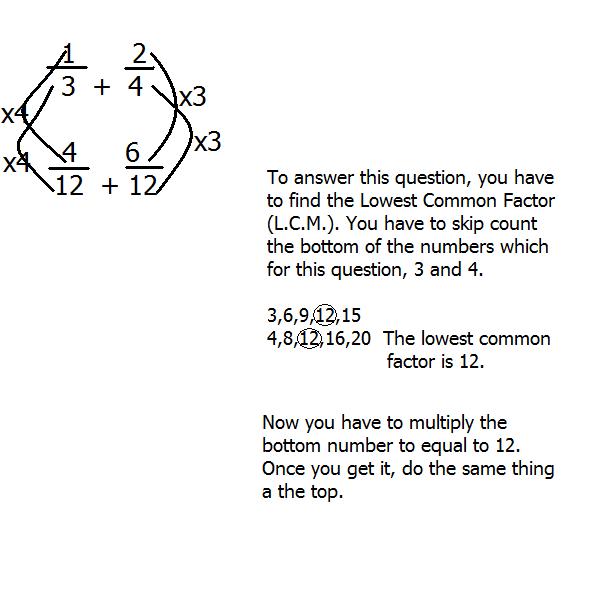
L.C.M (Lowest Common Multiple)


Here's one of the things we learned in math for the past couple months.

L.C.M is the number that is the first equivalent number that comes in when you add the number up.

For example;

What is the L.C.M of 4 and 8?

4, 8, 12, 16
8, 16

And that's you answer! 16 is the L.C.M of 4 and 8.

Adding Fractions


Wednesday, December 21, 2011

What is a numerator and a denominator?


- A numerator is the top number of a fraction that tells us how many parts of the whole we have or are dealing with.

Example:


- A denominator is the bottom number of a fraction that tells us how many equal parts of the whole is divided into.

Example:


Tuesday, December 13, 2011

L.C.M.

Textbook Chapter Review Pg. 146-147

Textbook Chapter Review
Pg. 146

#4
Show How to Find Each Amount


1. Make a ratio table
2. Label the percent and number column
3. Put 100 under the percent
4. Then put your number, in this case 124
5. Divide and/or multiply to get to the asked percentage and in this case it's 75
6. Do the exact same thing to the other side.

Monday, October 31, 2011

Order of Operations

B- Brackets
E- Exponets
D- Division
M- Multiplication
A- Addition
S- Subtraction


Here is a picure about BEDMAS


Here is a video about Order of Operation


Here is more information